Frequently Asked Questions (FAQ)

What can PINES Wheat
Grass do for me?
Or put another
way: what can eating enough green vegetables every day do for you?
Hundreds of
private and government studies suggest that increased consumption of vegetables
may reduce incidence of cancer and heart disease, and lead to fewer health
problems across the board. However, if you are in among the 9 of every 10
people who fail to eat at least 3-5 servings of vegetables every day, you
clearly could use a convenient source of greens.
PINES Wheat Grass
is that source. In less than a minute a day (and for as little as 50 cents per
day) you can get 2 to 3 servings of greens. How is that possible? PINES Wheat
Grass is nutritionally equivalent to a spinach salad, but much more concentrated.
How much
more? Seven tablets or one teaspoon of powder supplies about the same nutrition
as a serving of spinach.*
Our
products are guaranteed, so give them a try for a month and see how you feel.
If you’re not satisfied, we’ll refund your purchase price. It’s that simple.
* Based on
a 50 gram serving of spinach
___________________________________________________________________________________________________
What is Wheat Grass?
PINES Wheat Grass
is the young wheat plant, grown under optimum conditions, carefully harvested
at it’s nutritional maximum, dehydrated, and bottled for your convenience. For
more details, click on the following links:

___________________________________________________________________________________________________
What is the recommended serving size, and
servings per day?
For PINES Wheat Grass, Barley Grass, or Alfalfa:
7 tablets or 1-1/4 teaspoon of powder (3.5
grams) is the recommended serving size.
This 3.5 gram size is the equivalent of a
single serving of dark green leafy vegetables as defined by the USDA. Two to three servings per day will ensure you get a
beneficial quantity of organic greens every day.
The benefits of eating your greens every day
come from consistency over time, which is why we emphasize the convenience of
our products. If they are easy to take, you will be more likely to stick with
it over time, and when you do, you will experience for yourself the amazing
benefits our products offer.
Please see below for recommended serving sizes of other PINES
products:
Mighty Greens Superfood Blend: 1 tablespoon (8
grams), 1 serving per day
PINES Beet Juice Powder: 1 tablespoon (6
grams), 1 serving per day
PINES Green Energy Capsules: 5 capsules (3
grams), 2 to 3 servings per day
PINES Wheat Grass Juice Powder: 2 teaspoons (4
grams), 1 to 2 servings per day

___________________________________________________________________________________________________
How many servings
should I take per day, and when is it best to take them?
The answer to the
first is: it depends.
In general, 2 to
3 servings per day is good, because humans benefit from at least that many
servings of greens every day. It’s a great foundation for health, at minimal
cost or effort.
We have customers
who take as little as 1 serving per day, on up to as many as 5 to 7 servings
per day. So feel free to experiment to see what works best for you.
Ideally, take
your wheat grass (or barley grass or Mighty Greens) between meals with a good
amount of water or other liquid. This helps your body take full advantage of
the nutrients without competing with other foods, and may also take the edge
off your hunger so you don’t eat as much at meals. Mid-morning and
mid-afternoon are great times for a green energy pick-me-up.
However, what’s
most important is that you take it at a time that is convenient for you, so you
get your greens every day. For many people, that means right away in the
morning, or right before bed. That way you are sure to start (or end) your day
on a healthy note.
___________________________________________________________________________________________________
Are PINES products
organic?
PINES Wheat Grass
Powder, Barley Grass Powder, Wheat Grass Juice Powder, and Beet Juice Powder
contain only organic ingredients.

PINES Wheat Grass
Tablets, Barley Grass Tablets, and Alfalfa Tablets contain 98% organic
ingredients.
Mighty Greens
Superfood Blend contains many organic ingredients, and has tested herbicide and
pesticide free, but it does not have enough certified organic ingredients to
qualify as organic. (70% organic ingredients is the level at which one can put
the word "organic" on the label other than in the ingredients
listing.)


___________________________________________________________________________________________________
Do you have recipes?
Absolutely. Click Here.
___________________________________________________________________________________________________
Do you have nutritional analyses?
Of Course. Click Here.
___________________________________________________________________________________________________

Is PINES Wheat Grass
equal to a shot of fresh wheatgrass juice?
The nutritional
profiles of PINES Wheat Grass dehydrated whole leaf tablets and fresh juice are
quite different, so any comparison is a rough estimate. Given that, roughly 1/2
teaspoon or 3-5 tablets will offer similar nutrition to an ounce of fresh
juice.
However, there’s
much more to the story.
Differences in
soil conditions, growing time and environment lead to significant differences
in nutritional content. PINES Wheat Grass is much more nutritionally
concentrated and complete than fresh wheatgrass juice. Click here for a nutritional comparison.
Because PINES
Wheat Grass is grown as nature intended through cold months, outdoors in
temperatures that are often freezing at night, it can grow slowly as nature
intended. That results in a naturally concentrated, dark green leafy
vegetable that provides a wide array of vitamins, minerals, antioxidants, and
more, which are too numerous to be shown in our nutritional analysis.
Greenhouse or tray grown wheatgrass juice, while highly regarded by many for
its potential therapeutic value, simply isn’t given the time to develop fully,
and can’t compare nutritionally with wheatgrass grown the way nature intended.
It is grown far too quickly, and instead of seeds being an inch or so
apart as is natural to wheatgrass, the seeds are placed right next to each
other, making it impossible for the plant to develop properly. This leads
to mold and bacteria that can make the juice often taste bad and can lead to
stomach upset.
And finally,
PINES Wheat Grass costs between 20 cents and 50 cents per serving, while a shot
of wheatgrass juice at the store can be $2.00 or more per serving. And most
find that juicing wheatgrass at home is inconvenient, messy, and not economical
when time and equipment is taken into account.
___________________________________________________________________________________________________
I am allergic to
wheat/gluten. Is it safe to eat PINES Wheat Grass?
We recommend you check with your doctor or
allergist to be certain, but it is likely to be perfectly safe.
As you probably
know, wheat allergies are usually a reaction to the gluten found in the wheat
berry. PINES Wheat Grass is a vegetable, cut before the wheat plant forms the
grain (berry), and it is during the transition from vegetable to grain that
gluten begins to form.
We have done
multiple tests on our whole leaf products and never had a detectable amount of
gluten in our whole leaf wheat grass or barley grass.
In our wheat
grass juice powder, the highest gluten count we have seen was 11 parts per
million, which is below the FDA level of 20 parts per million for labeling as
“gluten-free.”
___________________________________________________________________________________________________
Can I take PINES
Wheat Grass during pregnancy?
PINES Wheat Grass
(or Barley Grass, or Alfalfa) is perfectly safe to take before, during, and
after pregnancy.
In fact, it’s
probably smart to eat PINES Wheat Grass and other organically grown greens
during pregnancy, since they are a good source of folic acid, as well as many
other important nutrients.
PINES Wheat Grass
is also safe and nutritious for babies and children.
___________________________________________________________________________________________________
Which is better,
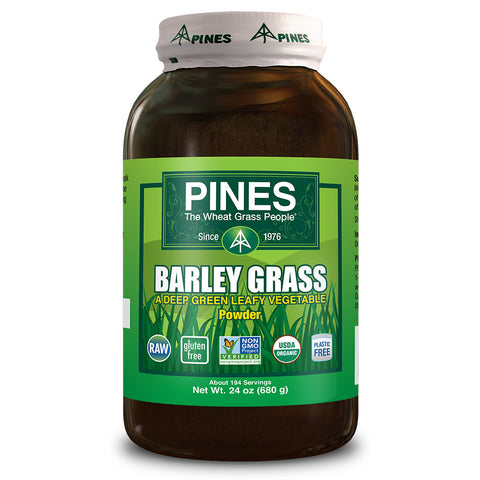
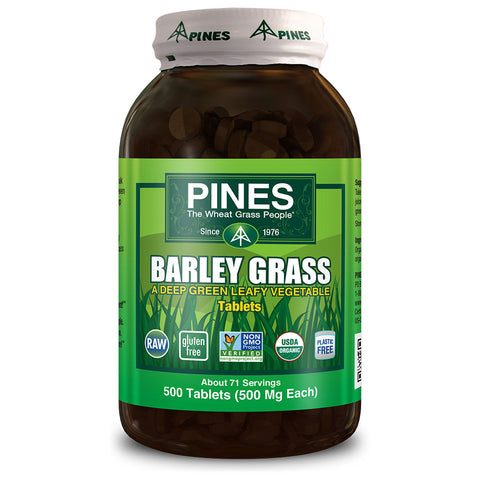
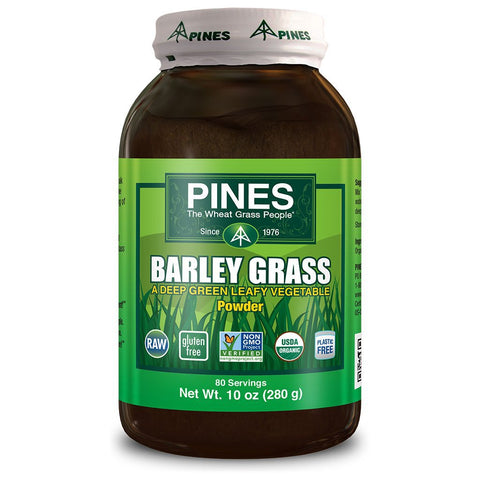
Barley Grass or PINES Wheat Grass?
There is little
nutritional difference between PINES Wheat Grass and PINES Barley Grass.
However, barley
grass products that we’ve tested from other companies have proven to be
nutritionally inferior to PINES grasses, sometimes significantly inferior.
For those new to
the grasses, we usually recommend PINES Wheat Grass based on reports from
customers that they prefer the taste over barley grass.
___________________________________________________________________________________________________

What makes PINES
Wheat Grass better than other Wheat Grass or Barley Grass?
The simplest
answer is that PINES Wheat Grass (and PINES Barley Grass) offer more nutrients
per penny than any other wheat grass or barley grass products on the market.
A few other
reasons you may feel better buying from PINES:
We were the first
company in continuous operation in the U.S.A. to offer dehydrated wheat grass
and barley grass to the public, starting in 1976. (To be fair, we were the
first after a couple decades hiatus. In the 1940s and 50s, Cerophyl was the
multivitamin of choice for thousands of Americans, prescribed by doctors for
diseases borne of nutritional deficiencies. Cerophyl was simply dehydrated
cereal grass, grown and processed in much the same way we do, though we’ve made
some improvements over the years.)
We grow and
process our products in the U.S.A., and are privately owned by mostly local
shareholders, so the majority of profits that don’t go into wildlife refuges or
converting land to organic farming make a short stop in our pockets before
going back into our local community.
Additionally,
there are differences between green foods packaged in plastic versus our
nitrogen-packed amber glass, including:
1. Glass is
completely non-toxic.
2. The
oxygen-free atmosphere inside our glass bottles stops oxidation. The only other
way to stop oxidation is to freeze the product.
3. Even after
being opened, glass bottles keep product fresher than plastic. Plastic is a
porous material that cannot hold a 100% nitrogen environment. Glass is not
porous and gives off no chemical residue.
4. So, if you
want the best, look for products packaged by PINES under our rigid quality
control standards.