Language:
Currency:
VAT Mode:
The History of Wheatgrass

Dr. Charles F. Schnabel was first to discover the health benefits of wheatgrass in 1925. After he published his first paper, dozens of scientists, medical doctors and other health practitioners produced a significant body of research on wheatgrass during the 25 years between 1925 and 1950. A close examination of the bibliographies of books on wheatgrass, including those that propose growing wheatgrass indoors, list research studies by Schnabel and by other scientists.  

What most authors of books and articles on indoor wheatgrass, including Ann Wigmore, fail to mention is that the research by scientists and medical doctors they discuss and list in their bibliographies never used indoor-grown wheatgrass juice for their research. They used dehydrated wheatgrass powder made from plants that were grown outdoors. The wheatgrass powder in their studies started as seeds that were planted in the fall, an inch apart, outdoors in the fertile glacial soils of northeastern Kansas. These plants were allowed to grow slowly in the cool fall temperatures. The roots of each plant grew deep and spread wide in uncrowded conditions. This allowed each plant to build high mineral and nutrient levels from these rich soils and long periods of direct sunlight.  The plants grew very slowly under these natural conditions through the cold Kansas winter for 200 days before the short, fleshy, deep green leaves of wheatgrass were harvested in the spring, dehydrated as a wholefood and milled into a fine powder.


Dr. Schnabel was an agricultural chemist. Before his documentation of the nutritional density of wheatgrass and other cereal grasses, the primary purpose of his early research was to determine the value of various animal feeds to see which would produce the best results for livestock. Very little was known about the nutrients that were in their food. It was known that amazing results occurred when cattle were allowed to graze on wheatgrass in the spring prior to what the farmers called “the jointing stage.” Beef cattle showed tremendous weight gain. Dairy cattle increased in milk production and butter fat by more than 30% if they were allowed to graze on wheatgrass.

In an interview with Ron Seibold in 1981, Dr. Schnabel’s son told the story of how his father walked out into a wheat field in the early spring of 1925 when the wheatgrass was only eight inches tall. Dr. Schnabel harvested some by hand with a pair of scissors. The wheat had been planted the previous fall in the fertile, alluvial, glacial soil of northeast Kansas. Although it was still below freezing at night, the wheatgrass had become deep green and lush in the warmer daytime temperatures of early spring. He took the freshly harvested leaves back to his home and dried them over a radiator. He then ground them, mixed a small amount (6%) into chicken feed and carefully documented the results. The hens in his study went from an egg production rate of about 30% to over 90%. In other words, hens that had been laying an egg every three days now started laying an egg almost every day. He published his results and after that, the research on wheatgrass and other cereal grass took off for both farm animals and humans.


It was an exciting time for food scientists. A year after Dr. Schnabel dried the wheatgrass in his home, another scientist, Dr. Saunders, published his landmark research titled, “The Nutritional Value of Chlorophyll as Related to Hemoglobin Formation.” It was published in the Proceedings of the Society for Experimental Biology and Medicine in 1926. Dr. Saunder’s research led to decades of intense study of the effects of chlorophyll on the human body, particularly its blood building and detoxifying qualities. The source of chlorophyll for most of that research came from dehydrated wheatgrass that Dr. Schnabel provided.  Most of this chlorophyll research dovetailed with other wheatgrass research by Dr. Schnabel, other scientists, medical doctors and clinics.

Meanwhile even more scientists worldwide were at work at understanding more and more of the components in food. Shortly before Dr. Schnabel’s first research on chickens, Vitamin D was discovered in 1922. Although Vitamin A had been discovered in 1913, it was not until 1929 that beta-carotene was found to be a source of it. Vitamin K was first isolated in 1929. Vitamin C was known but was not isolated until 1928. Folic Acid would not be discovered until 1933. It was not until 1938 that Vitamin E was discovered.

Certainly, Dr. Schnabel knew cereal grass was a rich source of chlorophyll. It was a much darker green color than common leafy garden vegetables. All the chlorophyll research made it abundantly clear that the greener the plant, the more chlorophyll was in it. As new vitamins were discovered, Dr. Schnabel felt certain that dehydrated wheatgrass would also be high in vitamins because of its profound effect on chickens and cattle. He was anxious to know what its effect would be on humans.

Using the wheatgrass he had dried on the radiator in his home, Dr. Schnabel ground up some more and started mixing it with the milk that his children drank. During the next winter, they had no colds or sickness and were the picture of health. He continued to give dehydrated wheatgrass to his family after that.

Dr. Schnabel realized that he had found a new course of study in his professional life, but first he needed to develop a dehydration method that would produce a larger quantity of dehydrated wheatgrass and other cereal grasses. With the help of investors, he built a laboratory and dehydration facility at Midland, Kansas. After exploring various existing drying methods, Dr. Schnabel developed a low-temperature drying process that would quickly remove the moisture from fresh wheatgrass in a rotating drum. Although hot air went through the drum as the leaves tumbled on their way through it, the process happened quickly (less than a minute). Because the plant was giving up moisture so rapidly, the heat never penetrated beyond the outer skin. The internal temperature of the leaf stayed at a temperature of just over 100 degrees Fahrenheit.


Over the years this original low-temperature drum dryer has been replaced several times, Pines International has owned the facility and Schnabel’s original laboratory since 1984. The low-temperature drying process now used by Pines is greatly improved and is computer controlled to insure the highest quality, but the basic principle is still the same.


With the development of his low-temperature drying process, Schnabel now had ample amounts of dehydrated wheatgrass to provide to other laboratories for their research. As new vitamins were discovered and isolated, Dr. Schnabel and respected scientists all over the world, such as Dr. George Kohler, Dr. G.A. Emerson and Dr. C. Von Wendt, carefully measured the vitamin content of dehydrated cereal grasses. Other scientists as far away as South Africa and Russia also were studying cereal grass, but it was Dr. Charles Schnabel and his team of scientists at Midland who focused the most attention on wheatgrass and other cereal grasses.

Dr. Schnabel and the other scientists dried wheatgrass at various stages of growth. They dried it in the fall, several weeks after germination. They also dried it in the spring on a daily basis up to and after the “jointing stage.” The level of each vitamin and protein content increased each day until the jointing stage and then rapidly dropped off.

The jointing stage is when the almost microscopic grain ovule begins its journey inside a developing stalk. This tiny head of grain grows quickly inside the stalk as it moves upward. It is fed in that journey and grows in size due to the nutrients in the cereal grass. The scientists learned that after jointing, when the stored nutrients go to feed the rapidly developing ovule, the nutritional level quickly drops. Within a few weeks, all the nutrition that was stored in the young cereal grass has gone to provide the nourishment needed to produce the grain. Curiously, the chemical composition of the grain is much different than the cereal grass that provided the nourishment. For example, the wheat grain contains gluten while wheatgrass contains no gluten at all and is basically the same nutritional composition as any dark green vegetable but in much greater concentration.


The scientists also found no significant nutritional difference between the young grasses of wheat, barley and rye, but each grass followed the same pattern of increasing nutrient levels up to the jointing stage followed by a rapid decline in nutrients as the grain developed inside the stalk.

The scientists did find significant differences in where the cereal grass was grown. They tested wheatgrass grown in various locations in Kansas and in other wheat-producing states. There was no location found to produce as high of quality of cereal grass as northeastern Kansas. The reason the soils are so special in this one area of Kansas compared to any other area is the last major glacier stopped there. It had traveled thousands of miles like a bulldozer churning up minerals and pushing rich top soil toward Kansas. When it stopped in northeastern Kansas. all the fertile topsoil and minerals it had collected were dropped off in what the geologists call “loess.” Thick deposits of loess, more than a hundred feet thick were left behind in northeastern Kansas when the glacier receded. Over thousands of years, the mineral-rich, fertile topsoil from the loess filled the valleys of northeastern Kansas and made the farmland there among the richest and most fertile in the world.


Dr. Schnabel and the other scientists discovered that the concentration of nutrients as cereal grass approaches the jointing stage is the highest of any dark green leafy vegetable. It is so high, that Dr. Schnabel rounded up investors to commercially produce dehydrated cereal grass as the "world’s first multi-vitamin." It was sold under the name Cerophyl. The label said, “Cerophyl contains one or more of the following cereal grasses: wheat, barley, rye and oats.” This left the company open to blend any combination of cereal grass; however, in general Cerophyl was primarily wheatgrass.

Through their analysis, the scientists determined that 20 cereal grass tablets, grown in the glacial soils of northeastern Kansas and harvested just prior to the jointing stage, were equal to what was considered to be the minimum daily requirement of all the known vitamins and most of the minerals.


The timing for the new product was perfect. The public had been following with great interest the discovery of each new vitamin and were clamoring for a convenient and economical way to increase the vitamins in their diets. The sale of Cerophyl tablets took off like a shot. Soon, nearly every pharmacy in the United States and in several other countries stocked Cerophyl on their shelves. Medical doctors routinely prescribed Cerophyl as medical journals reported research findings in studies using Cerophyl. The research indicated all sorts of positive results when Cerophyl was added to the diet.

The blood building components and the high folic acid content caused many gynecologists to prescribe Cerophyl for pregnant women. One published study showed that young girls had less bleeding during their menstrual cycles after including Cerophyl tablets in their diets. Studies on secondary anemia showed similar results. Medical journals published studies by gynecologists, opthamologists, dentists and other medical professionals in various fields documented positive research results by adding Cerophyl to their patients’ diets.


At the same time as all the human research was going on with Cerophyl, the animal research with “unjointed dehydrated cereal grass” continued. Just as gynecologists found that human mothers gave more milk and richer milk with cereal grass tablets in their diets, animal feed researchers found that adding only a small percentage of dehydrated cereal grass (usually about 6%) to the ration of hogs, horses, cows, sheep and goats produced the same kind of results: more milk, richer milk, healthier babies and less infant mortality.

By 1939, the research and documentation of Cerophyl had become so impressive that the U.S. Food and Drug Administration published a statement in the Journal of the American Medical Association accepting dehydrated cereal grass as a food.


Also in 1939, Dr. George Kohler and other scientists began guinea pig studies in which control groups were given foods like fresh carrots, spinach and other greens, which were known to have basically the same vitamins as cereal grass. The experimental groups were given the same diet as the control groups, but a small amount of dehydrated cereal grass was added to their diet. In every case, the addition of cereal grass caused the animals to grow faster, larger and show greater overall health as evidence by their fur, eyes and energy levels.

The scientists were mystified. They referred to this phenomenon as “the unidentified vitamins of cereal grass.” It was also known as the “grass juice factor.” To this day, scientists have yet to determine what cereal grass contains that other vegetable do not contain. Some have speculated that it is abscisic acid or other compounds associated with the growth and reproductive nature of cereal grass. Abscisic acid is present in dehydrated outdoor grown cereal grass when it is grown in cold weather. It is believed that abscisic acid is what slows the growth of cereal grass during cool weather and is the reason wheatgrass that has grown for 200 days through the winter is still shorter than wheatgrass grown indoors for ten days. Some scientists have speculated that since the abscisic acid slows the growth of the cereal grass plant, it might be effective in slowing the growth of tumors, but research has yet to demonstrate it.


Whatever it is that wheatgrass has (besides extremely high nutritional density) that other vegetables do not have, the research on the grass juice factor did not prevent the loss of market for Cerophyl when one-a-day pills made of synthetic vitamins began to appear in the late 1940s. Cerophyl, the world’s first multi-vitamin, started to go out of style. This was a time when “natural” was not in the consciousness. In fact, it was a time when people celebrated “the miracles of modern science.” At last, you no longer need to take 20 tablets a day for your vitamins and minerals. Now, you could take just one.

One-A-Day pills proved disastrous for Cerophyl. The company saw its market share drop very quickly. The company tried to offset the problem by producing a product called “Viet” (rhymes with “try it”). Viet was dehydrated cereal grass in a tablet form that was fortified with synthetic vitamins. You could now get your vitamins by taking just 4 Viet tablets rather than 20 Cerophyl tablets. Viet was unsuccessful in competing with One-A-Day and other synthetic vitamins.

Cerophyl, however, continued to have a limited-but-slowly-declining market because many people still depended on it not just for its vitamins and minerals.  They also recognized that it was an important roughage that helped  keep them "regular."

But slowly, over time, as enthusiastic Cerophyl customers grew old and passed away, the market became even smaller until all that was left of Cerophyl was a filing cabinet, some literature and a few cases of the product in the office of another company.  This company kept a list of active customers.  It included several hundred direct retail customers and a few remaining pharmacies that still sold the product. To supply these customers, they kept an inventory of dehydrated wheatgrass in frozen cold storage and would draw on it whenever they needed a production company to make more bottles of tablets and powder.

Besides the remaining pharmacies, several University laboratories still ordered the Cerophyl powder. It was being used as a growing media for one celled animals and for probiotics, including various strains of lactobacillus. These labs found that dehydrated cereal grass with it high nutrient content and excellent vegetable fiber was a perfect media for growing these friendly bacteria that are essential for good digestion in humans.

In 1975, Pines’ co-founder and president, Ron Seibold worked in the office that stored the remains of Cerophyl. He spent months studying cereal grass research and the sales history of Cerophyl and Viet. He began to take Cerophyl tablets himself and noticed an immediate increase in energy, better bowel movements and a noticeable improvement in his skin.


Ron grew up on a farm and already knew the strong health effect of wheatgrass in the spring after a winter of slow growth. His father and other farmers in northeastern Kansas pastured their cattle on wheatgrass in the spring prior to the jointing stage. It was common knowledge that wheatgrass would bring health to sick animals and increase their milk production. Ron had instinctively chewed the leaves of wheatgrass in the spring as a boy and remembered the rush of energy he had felt.

With that knowledge and experience, Ron eagerly set about reading all published research in medical journals that had used Cerophyl in their studies. He also read the massive testimonial file. The testimonial file only went back only 20 years, but it weighed more than ten pounds. It took Ron weeks to go through all the letters. He was amazed at how many people had taken the time to write letters praising the product. Many had overcome serious health problems and believed Cerophyl had been responsible.

After reviewing all that research and testimonials, Ron decided to establish a company to reintroduce dehydrated wheatgrass, not as a vitamin, but as a convenient and economical dark green, leafy vegetable. He met Steve Malone in Hays, Kansas in 1976, and the two men promised each other they would commit to the vision and make the new company a reality. Rather than approaching big investors or banks, Steve, who was a lifelong resident of Hays, lined up most of the investors. The two men convinced more than 200 people to invest an average of $200 each in the entities that merged into Pines International. Their vision was more than just marketing wheatgrass. They wanted to promote the American free enterprise spirit. The year 1976 was the bicentennial for America. In the aftermath of the Vietnam War, many were disillusioned with the American system. Ron and Steve wanted to prove that the pure spirit of free enterprise and economic democracy were still alive in America.


They also wanted Pines to be known as an honest company with integrity that cared about improving the health of people. They wanted Pines to be a company that also cared about its employees and cared about the future of the planet. A part of their dream was to discourage further loss of America’s farmland by converting as much of it as possible into organic agriculture.

They believed in the power of the common people to pool their meager resources and build an international company that would stand the test of time. They chose the name “Pines” in recognition that the Pine tree as an internationally-recognized symbol of the peace that exists in nature. The investors, employees, customers and everyone associated with Pines International were like trees in a pine forest. It is often said, “One pine tree does not a forest make.” And it is also often said, “In a forest, each pine tree grows tall to keep out of each other’s shadows.” Each of us is unique, but we are all part of greater efforts that grow strong not because of one individual but because of the cooperative effort of all the individuals involved. It seemed the perfect analogy of the philosophy that had drawn so many people together into Pines International.

Steve and Ron started the company with $8,000 in cash from some of the original stockholders. The rest of the original stockholders were issued stock in return for services. The employees were paid in stock. The farmer and dehydration company also received stock instead of money. 

After the first harvest, Steve and Ron hit the road with their message that Pines Wheat Grass is an economical and convenient way to get more vegetable nutrition and fiber in your diet. The office was shut down and moved to the home of stockholders who, on a voluntary basis, took care of shipping the orders and answering the mail and phone.


Meanwhile, it was up to Steve and Ron to develop a market for the new product. They stayed at campgrounds at night and used campground showers and bathrooms to prepare for spreading their message during the day. At first they tried to market Pines Wheat Grass as a multi-level product patterned after Amway. After two weeks of hard work, it was clear that business plan was going too slowly. Bills for harvesting supplies, cold storage, tableting, bottling and shipping were soon going to be delinquent. Steve and Ron had to change plans.

On a whim, they stopped into a health food store in Denver. The store owner bought six bottles of Pines Wheat Grass. The pair then started going from store to store in Denver. Most store owners understood Steve and Ron’s message about eating more dark green, leafy vegetables and fiber. After only a few days, the pair had sold enough Pines Wheat Grass to enough stores that they were able to convince a distributor to health food stores in Colorado to carry Pines Wheat Grass and supply it to the stores.

Ron and Steve repeated that pattern throughout the United States during the next eight months. When they were finished, Pines Wheat Grass was being sold in more than 2,000 stores in the 35 states they had visited.
.


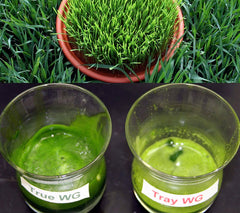
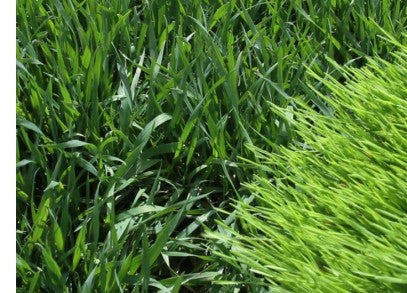
Steve and Ron began to hear that some people were growing wheatgrass in about 10 days indoors. Because they knew how wheatgrass was supposed to grow, they immediately realized that there was nothing natural about growing wheatgrass indoors in a tray.  Yet, people were being led to believe that wheatgrass was supposed to be grown in a tray. The truth is that tray wheatgrass grows 20 times faster than it grows in nature, and the seeds are far too close together.  When they saw the first tray of indoor grown wheatgrass, they quickly understood that the warm crowded conditions made tray wheat grass look very pale and spindly compared to the real thing!

Worse, this unnatural way of growing wheatgrass was being “supported” by the research conducted by Dr. Schnabel, other scientists and medical doctors, who did not use tray grown wheatgrass, but instead used the exact same product as Pines Wheat Grass.  Even more outrageous, some tray wheatgrass enthusiasts said some very derogatory things about Pines Wheat Grass. In other words, the research on Pines’ predecessor product, Cerophyl, was being used to justify growing wheatgrass in the most unnatural way possible, and then indoor wheatgrass proponents, who had used the research on Cerophyl, went out of her way to run down the exact same product that was responsible for the research!

Although they were in disbelief at this strange and ignorant reasoning, Steve and Ron believed such ignorance was actually a “blessing in disguise” because it made a distinction between indoor wheatgrass and real wheatgrass grown as nature intended.  They continued to do everything they could to make it clear that Pines Wheat Grass was grown in an entirely different way than tray grown. At every health food store they visited, Ron and Steve emphasized that Pines Wheat Grass was not a miracle cure. They emphasized that it was simply a very concentrated source of the chlorophyll, vitamins and minerals in dark green, leafy vegetables. 

They really did not want to be associated with tray-grown indoor wheatgrass and some of the wild health claims that were being made about it. All they would say with regard to the amazing results people had had for nearly 50 years with wheatgrass (even the pale tray-grown variety) was this: "The Standard American Diet (SAD) is very deficient in green food nutrients. Because of that, when people take Pines Wheat Grass or a even a shot of the weaker tray-grown juice, amazing things often happened because people are finally getting the kind of nutrition that their bodies have been craving."


The company was located in Hays for the first three years. Pines had been outsourcing everything including farming, dehydration and tablet making. The company had depended on another company for bottling until they returned from their travels. After that, they filled the bottles in Hays but still had to ship the dehydrated wheatgrass off to Nevada to have it made into tablets before being shipped back to Hays.

Steve and Ron had developed a business plan that showed that the company could start making a profit if it had its own equipment. They approached bankers in Hays, but Hays is in Western Kansas, where the economics are based on cattle and oil.  None of the bankers in Hays were interested, but they did find a bank on the other side of the state in Lawrence that would work with the company to obtain a small business loan.  After receiving the loan, Steve and Ron moved their bottling equipment to Lawrence late in 1979, purchased a building, tableting equipment, and a much-needed tablet counting machine.


Ron had forgotten that Cerophyl had been located near Lawrence. In 1984, Steve and Ron were looking for a location for expanding their operation. They found themselves at an old alfalfa processing plant outside of Lawrence at Midland that had been shut down a few years before. As they toured the buildings, Steve saw a stencil with the word, “Cerophyl.” Both he and Ron nearly screamed with joy. They were standing in the same building that contained the actual laboratory Dr. Schnabel had used. “Yes,” the owner said, “The plant used to be owned by Cerophyl laboratories and was used to dehydrate wheatgrass!”


In 1987, Ron and Steve obtained another small business loan and built a new building at Midland and moved their offices, tableting and bottling facilities there. With the market for Pines Wheat Grass taking off in Asia and increased sales in the United States, the company built a second new building in 1991.


After 35 years, the two men, the 200 shareholders and all the employees are fulfilling the vision that began in 1976. So far more than 2,000 acres of farmland has been converted to organic farming, millions of people have benefitted from Pines Wheat Grass and now hundreds of companies worldwide are selling green food products. Many are using the same message and some even use the exact phrases that Steve and Ron invented many years before. Regardless of how they word it, all are basically saying what Ron and Steve have said for 35 years, “Eat more green!”